
Are You Struggling with Heavy or Oversized Workpieces in Your Press?
Frequent handling and positioning of heavy parts can lead to significant physical strain on operators, not to mention potential safety hazards.
So, how can you enhance efficiency and safety in these demanding environments?
Challenges in Traditional Operations
In conventional processes for removing and handling metal parts from presses, workers often rely on manual labor or basic lifting tools. This method not only requires sustained concentration but also presents challenges due to the large size and weight of the components.
These workpieces are not only prone to surface damage but also pose risks of dropping or tipping during handling. Moreover, the repetitive physical demands can lead to chronic injuries in workers, increasing the risk of workplace accidents.
Case Study: Overcoming Challenges in Metal Parts Handling
A manufacturing facility specializing in die-cast parts faced numerous challenges when extracting and transporting metal components weighing between 50-80 kg in confined spaces. Workers had to ensure precise positioning while preventing collisions and falls, often relying on a combination of manual handling and rudimentary lifting tools. Each operation required constant posture adjustments and strenuous pushing and pulling.
As production volumes increased, the facility experienced declining efficiency and rising fatigue levels among workers, alongside a notable uptick in injury rates. In response to these challenges, management decided to implement a dedicated assistive robotic arm system to streamline the handling process.
Introducing the Robotic Arm Handling System
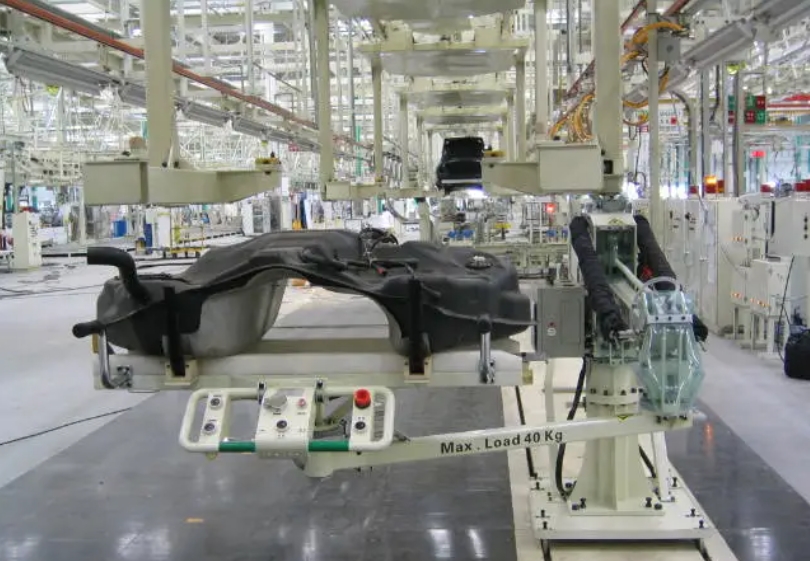
The system features the PBF-HM100 model hard-arm assistive robotic arm, equipped with a 45T electric flatbed. This innovative setup allows for seamless transfer of components between machines and efficiently moves workpieces to the conveyor at the end of the line.
Key Advantages of the System:
- Adaptive Balancing and Precision Positioning
The system achieves adaptive balance, enabling operators to effortlessly grasp and position heavy workpieces. Regardless of the load's weight, the robotic arm automatically adjusts to maintain equilibrium, facilitating easier handling. - Smooth, Stable Motion Control
With robust motion control, the system ensures stable, smooth movement throughout the process. Workers can operate without concern for sudden shifts or detachment of the workpieces. - Vacuum Gripper with Soft Material Protection
The integrated vacuum gripper allows for rapid and secure gripping of components, while a soft material layer protects against scratches or damage during handling. - Initial Positioning and Horizontal Stability
The initial positioning device ensures stability during grasping, keeping components level and reducing the risk of tilting during lifting and transport. - Error Protection and Load Monitoring
The system is equipped with an error protection mechanism that prevents release if the workpiece is not securely held. A load display indicates the weight, with a visual cue for safe handling. - Ergonomic Dual-Hand Control
The ergonomic control handle enables synchronized operation with both hands, enhancing accuracy and efficiency while minimizing operator fatigue. - Mobile Platform for Multi-Press Operations
The system includes a mobile platform and ground tracks, allowing the robotic arm to serve multiple presses simultaneously, significantly boosting productivity. - Safety Brakes and Drift Prevention
Safety brakes are installed at the arm's pivot joints, locking them when idle to prevent unintended movement. - Efficient Multi-Device Transfers with Electric Flatbed
The 45T electric flatbed facilitates seamless transitions between equipment, ensuring smooth operations from one machine to another, leading to quicker load and unload processes.
The introduction of the assistive robotic arm system in the manufacturing facility not only greatly improved production efficiency but also significantly reduced physical strain on workers, leading to fewer workplace injuries. With numerous safety features and automated controls, operators reported a much safer working environment, alleviating concerns about damaging components during transport.
By adopting this system, the facility enhanced operational efficiency while lowering labor costs and optimizing workflows. The decision to implement an assistive robotic arm received widespread approval from both management and staff.
In industrial settings, traditional handling methods are often inefficient and fraught with safety risks. By integrating advanced solutions like the PBF-HM100 assistive robotic arm, businesses can not only elevate their productivity but also significantly reduce the physical demands on workers, ensuring higher safety standards and improved economic returns.
Liftoal: Your Expert Partner in Industrial Handling Solutions
Liftoal is a trusted partner in industrial lifting and handling equipment, offering customized solutions to meet diverse operational needs. With over two decades of experience, Liftoal specializes in advanced labor-saving handling technologies that enhance efficiency, safety, and precision across various industries. Whether you need solutions for lifting heavy machinery, moving bulk materials, or optimizing assembly processes, Liftoal has the expertise and technology to support your manufacturing and logistics operations.
Contact Liftoal today for expert advice on selecting the right industrial lifting and handling equipment tailored to your specific requirements. Optimize your production processes and enhance workplace safety with Liftoal’s advanced solutions!