
Have you ever experienced decreased productivity due to the complexities of manual material handling?
In modern industrial manufacturing, especially in spare parts warehouses and material transfer processes, the labor intensity and efficiency of workers are key concerns for businesses. Improving productivity, reducing worker fatigue, and minimizing safety risks are critical challenges for many enterprise managers. Assistive robotic arms offer an innovative solution to these challenges.
How Do Assistive Robotic Arms Work, and What Are Their Advantages?
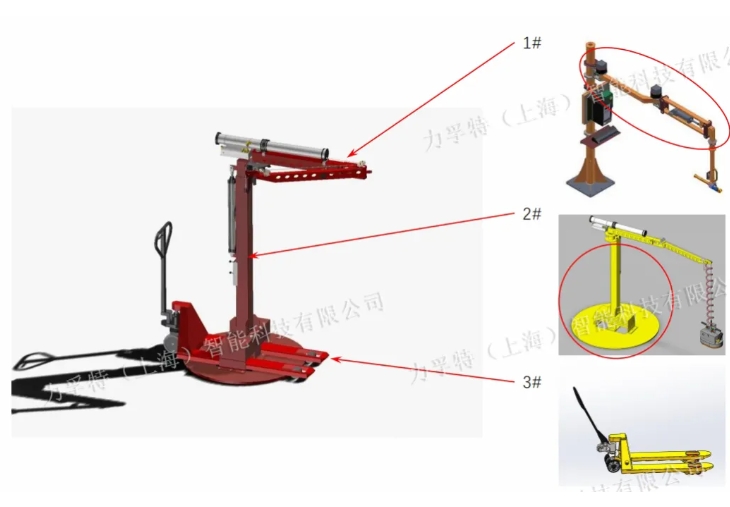
Let’s take the spare parts warehouse assistive robotic arm as an example. This system uses pneumatic balancing principles to enable floating balance operations of workpieces at any position.
How critical do you think precise workpiece positioning is to improving productivity?
Compared to traditional manual handling or electric lifting devices, pneumatic balancing arms provide the following benefits:
- Precision Positioning and Balanced Operations
The system employs advanced pneumatic balancing technology, allowing materials to float in a stable, balanced state within a certain range. This enables precise positioning of workpieces, making it suitable for multi-angle, multi-directional operations. This balance feature reduces the risk of damage due to misoperation while significantly alleviating operator workload. - Efficient Material Transfers
Equipped with a UP/DN handle, operators can achieve large-scale movement of workpieces effortlessly, ensuring quick and smooth material transfers. This is especially beneficial in confined warehouse spaces, where moving large volumes over longer distances is now more convenient. - Modular Design for Smooth Operation
The system features low-resistance aluminum alloy tracks with a modular design, making it adaptable to different working environments. The precisely engineered track system ensures smooth operation, allowing operators to move materials with minimal effort. According to a manufacturing journal study, the use of pneumatic assistive robotic arms can boost worker efficiency by up to 30% while reducing work-related injuries by 50%.
Case Study: Material Transfer Solution in a Spare Parts Warehouse
In one spare parts warehouse, various materials ranging from tens to hundreds of kilograms required handling. Traditional material handling methods often demanded two or three workers to coordinate tasks, consuming time and increasing the risk of injuries. After implementing the assistive robotic arm system, material transfer efficiency significantly improved.
- Increased Efficiency
With the pneumatic balancing arm, a single operator can now handle materials weighing up to 150 kg, with a lift range of up to 2000 mm, improving warehouse transfer efficiency by nearly 40%. - Reduced Risk of Injuries
The system uses a spiral air supply, eliminating the risk of electrical failures common in traditional electric systems. Following its introduction, incidents of worker injuries related to manual handling dropped drastically, reducing the company’s safety-related expenditures.
A New Perspective: From "Smart" to "Symbiotic"
When discussing assistive robotic arm applications, many businesses tend to focus on efficiency, cost, and safety. However, an often-overlooked dimension is the collaborative relationship between humans and machines. Traditional handling equipment often replaces manual labor, while assistive robotic arms serve as a bridge for human-machine collaboration, enhancing worker capabilities rather than replacing them.
Have you considered viewing machines as "collaborative partners" rather than mere tools?
From this perspective, assistive robotic arms are not just “lifting tools” but intelligent systems that create a seamless, efficient work environment through their precision controls. These systems respond to operator commands with accuracy, adapting to complex work scenarios and ensuring smooth human-machine collaboration.
For instance, the floating mode of the spare parts warehouse robotic arm not only enhances operational flexibility but also helps workers maintain their rhythm during high-intensity tasks, reducing fatigue from repetitive operations. Would you consider treating machines as “collaborative partners” rather than simply workforce replacements?
As technology advances, assistive robotic arms are evolving from “single-function” to “intelligent collaboration.” This trend towards human-machine symbiosis will become increasingly important in industrial production. Are you ready to experience this new collaborative approach in your workplace?
The spare parts warehouse assistive robotic arm system provides an efficient, safe, and labor-saving solution for material handling. With its balance floating, precision positioning, and easy operation features, it’s an ideal choice for modern warehousing and logistics operations. Would you consider leveraging such a solution to enhance your warehouse or production efficiency?
Liftoal: Your Expert Partner in Industrial Handling Solutions
Liftoal is a trusted partner in industrial lifting and handling equipment, offering customized solutions to meet diverse operational needs. With over two decades of experience, Liftoal specializes in advanced labor-saving handling technologies that enhance efficiency, safety, and precision across various industries. Whether you need solutions for lifting heavy machinery, moving bulk materials, or optimizing assembly processes, Liftoal has the expertise and technology to support your manufacturing and logistics operations.
Contact Liftoal today for expert advice on selecting the right industrial lifting and handling equipment tailored to your specific requirements. Optimize your production processes and enhance workplace safety with Liftoal’s advanced solutions!