
In today’s industrial landscape, improving operational efficiency, reducing labor intensity, and ensuring worker safety are key challenges for many businesses. This is especially true in industries where processes involve heavy or hazardous materials, such as lead-coated cable production. Traditional manual handling of lead ingots is often inefficient, labor-intensive, and poses significant safety risks. So, how can businesses improve production efficiency while minimizing manual labor and risks?
In this article, we will explore an efficient solution to optimize the lead ingot handling process using a pneumatic balance lifting system.
Part 1: Project Background
Our client is a cable manufacturing company facing a pressing need to optimize their production line. Specifically, they need to cover cables with lead sheaths, using melted lead ingots for the coating process. However, the traditional manual handling of lead ingots—each weighing up to 50kg—was proving to be physically demanding and risky for workers. To address these challenges, the client sought an automated, ergonomic solution to streamline this process.
Part 2: Challenges with Traditional Manual Handling
On many production lines, lead ingot loading still relies on manual labor, where workers use slings or steel cables to lift and move the heavy ingots. This traditional method presents several significant drawbacks:
High Labor Intensity: Handling lead ingots manually requires substantial physical effort, which can lead to worker fatigue and even cause injuries from repetitive motion or incorrect handling.
Inefficiency and Instability: Manual handling is slow, prone to human error, and can disrupt production flow. This leads to reduced productivity and unstable operational performance.
Safety Hazards: Improper handling or accidental mistakes can result in the ingot falling, potentially causing severe injury or damage. Worker safety is a major concern in such high-risk tasks.
Part 3: The Optimized Solution: Pneumatic Balance Lifting System
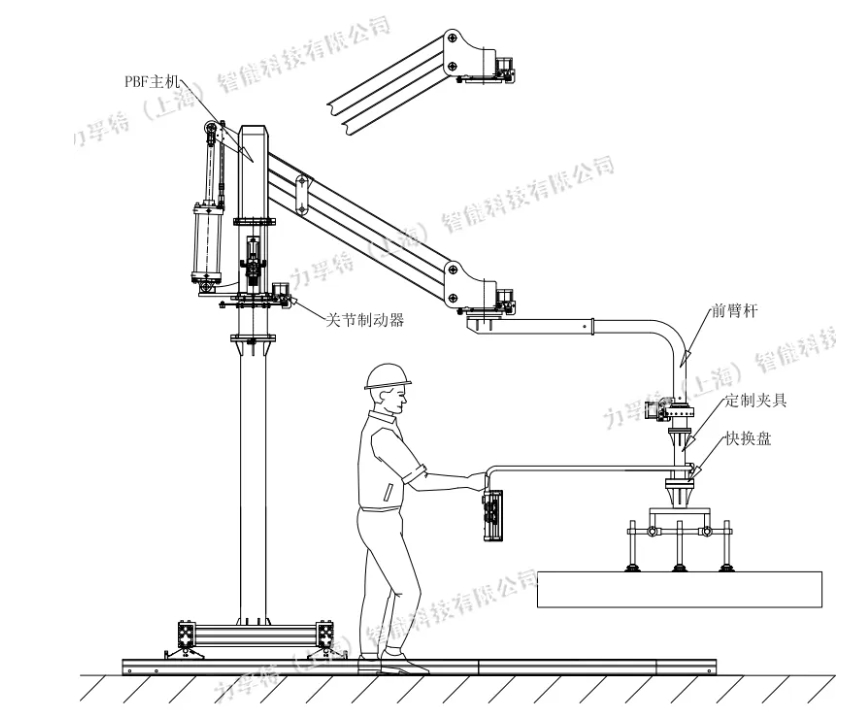
To address the client’s challenges, we designed an efficient, ergonomically-friendly pneumatic balance lifting system. This system is equipped with the necessary features to ensure safe, efficient, and precise handling of lead ingots:
System Overview:
- Pneumatic Balance Lifting System – 1 unit
- X-Y Suspension Aluminum Alloy Track
- Steel Structure – Ground-mounted columns and cantilever beams
- Single Power Source – Compressed air
One of the key advantages of this solution is its design: the steel frame is suspended above the working area, saving valuable floor space and allowing for efficient use of existing workstations.
The lifting system we selected for this project is the LIFTTECH IRB-225 Pneumatic Balance Lifter, with a load capacity of up to 225kg—well-suited for the 50kg lead ingots. The system features a vertical lifting range of 2,000mm and a track layout covering a 12,000mm by 3,000mm area, ensuring full coverage of the client’s production zone. The system also includes hook-type fixtures and the option to use slings or steel cables for hanging the ingots. The system can handle up to 3 ingots at once and includes two material input points for maximum efficiency and precision. Additionally, the balance lifting system offers adjustable up/down and floating balance functions, perfect for diverse handling scenarios.
Key Features:
- Vertical and Horizontal Movement: Smooth, balanced lifting and low-resistance horizontal movement.
- Integrated Controls: Control handle and hook are combined for ease of use.
- Simplicity and Mobility: Spiral air hose provides easy, lightweight operation.
Part 4: Pneumatic Balance Lifter vs. Traditional Electric Hoist
Compared with the traditional electric hoists on the market, the advantages of the flexible cable pneumatic balance crane are more significant than the traditional electric hoists, and the following is their comparison difference chart.
Electric hoist is suitable for heavy lifting, but the operation is cumbersome, and the space needs are large, and the movement is not flexible enough. In contrast, the flexible cable pneumatic balancing crane system is simple to operate, the lifting is balanced, the horizontal movement is smooth, the labor and space saving, the efficiency is improved, and it is suitable for the lifting scene that requires precise control.
The internal structure of the electric hoist mainly includes a motor, a reducer, a chain or a steel wire rope drum, which relies on electric drive to lift the load. The flexible cable pneumatic balancing crane is composed of pneumatic device, cylinder, flexible cable and hook. The load balance is adjusted by air pressure, and the structure is more simple and suitable for complex working environment.
| Comparison difference between electric and pneumatic balance crane system | |||
| NO. | Contrast item | Electric hoist | Pneumatic balancing crane |
| 1 | Mode of operation | One-handed operation | Bimanual operation |
| (One hand to operate the switch, one Hand control hook) | Both hands can control workpiece positioning at the same time. man-machine Engineering control handle) | ||
| 2 | Status indication | none | Load Reflector: When the system is on load. display It is red; After the system is unloaded, the display is white color |
| 3 | Security protection | none | Misoperation protection device: the weight of the workpiece is not unloaded When the work surface is effectively supported. Unload button Lose effectiveness |
| 4 | Balanced float | none | In any position within a certain range of balanced floating |
| 5 | Lifting action | The lifting action has an impact | Gentle lifting |
| 6 | Anti-sticking device | none | Can be equipped with differential anti-extension device |
| 7 | Rotating operating force | big | small |
| 8 | Translational operating force | big | small |
| 9 | Rotary brake | none | some |
| 10 | Power source | Gas and electricity mixed | Single power source: compressed air |
Conclusion
As production technology continues to advance, more and more companies are turning to powered lifting solutions to optimize their operations. By adopting a pneumatic balance lifting system, companies can reduce labor costs, enhance worker safety, and significantly boost productivity. This system represents a modern solution to the challenges of heavy-duty handling tasks, offering increased efficiency and a safer work environment for operators.
Whether you're working with lifting or handling materials in industrial environments, a pneumatic balance lifter can provide the support you need for safer and more efficient operations.
Liftoal: Your Expert Partner in Industrial Handling Solutions
Liftoal is a trusted partner in industrial lifting and handling equipment, offering customized solutions to meet diverse operational needs. With over two decades of experience, Liftoal specializes in advanced labor-saving handling technologies that enhance efficiency, safety, and precision across various industries. Whether you need solutions for lifting heavy machinery, moving bulk materials, or optimizing assembly processes, Liftoal has the expertise and technology to support your manufacturing and logistics operations.
Contact Liftoal today for expert advice on selecting the right industrial lifting and handling equipment tailored to your specific requirements. Optimize your production processes and enhance workplace safety with Liftoal’s advanced solutions!