
In modern industrial manufacturing, surface grinding is an essential process, especially when dealing with large workpieces. The complexity and difficulty of these operations increase significantly, necessitating not only efficiency but also the safety of operators. Traditional grinding methods present several challenges: the weight of the equipment, torque during operation, and the physical strain of prolonged use make the entire process cumbersome and hazardous.
Challenges of Traditional Grinding Operations
In a large manufacturing facility, operators face the daily task of using grinding equipment on sizable workpieces. While traditional manual grinding tools can complete the job, their weight and the torque generated often leave operators fatigued. When precision is required, the heaviness of the equipment not only hampers efficiency but also heightens the risk of errors, compromising the quality of the grind.
Moreover, the torque generated during grinding creates instability, particularly when operators work in challenging areas. For instance, during a critical operation, an operator experienced instability due to the reactive force of the equipment, negatively affecting the surface finish and incurring additional rework costs for the company.
These challenges prompted the search for a safer, more efficient grinding solution that reduces physical strain on operators while ensuring quality surface treatment. Thus, we introduced the Force-Controlled Robotic Arm Grinding System.
Force-Controlled Robotic Arm Grinding System
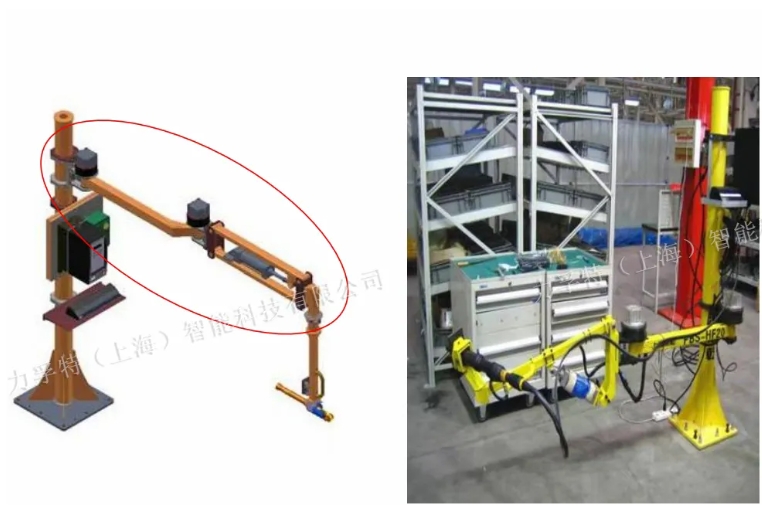
To tackle the difficulties of surface grinding on large workpieces, we developed a mobile column-mounted anti-torque arm system combined with a force control mechanism to minimize weight and torque impacts. The system’s core component is the PBS-SM30 anti-torque arm, which, in conjunction with a customized force control head and hydraulic pallet truck, optimizes the entire operation.
1. PBS-SM30 Anti-Torque Arm
The PBS-SM30 is designed to handle the torque challenges associated with grinding, offering a rated torque of 30 Nm and a working radius of 2000 mm. This enables operators to easily address grinding needs from various angles, ensuring both stability and precision throughout the grinding process.
For example, during a production run requiring edge grinding, operators can easily adjust the grinding tool to a vertical position for precision work, maintaining stable operation through the force control head. The tool can also be swiftly repositioned for angled or horizontal grinding, enhancing flexibility and ensuring uniform treatment across all surfaces.
Ps: Custom connection chuck case (the gun head can swing vertically down, the gun head can rotate vertically up right Angle, the gun head bevel Angle can rotate upward right Angle, the gun head horizontal right Angle can rotate)
2. Column-Mounted Beam System
The column-mounted beam system offers greater operational flexibility and reach. With a maximum height of 2500 mm and a minimum of 1500 mm, it allows pneumatic height adjustments, enabling operators to maintain comfortable working postures during grinding.
In one project, operators needed to grind surfaces at varying heights. The previously fixed-height equipment proved cumbersome, but the beam system allowed for easy height adjustments, facilitating efficient grinding while reducing fatigue and errors caused by awkward positioning.
3. Hydraulic Pallet Truck
To further enhance convenience, we implemented a hydraulic pallet truck with a load capacity of 2000 kg. This simplifies equipment mobility and the adjustment of workpiece positions. In a busy workshop, operators can swiftly reposition equipment and quickly locate optimal working spots, saving considerable operational time.
Advantages of the Force-Controlled Grinding System
This solution successfully addresses multiple pain points associated with traditional grinding operations:
- Weight Reduction: The combination of the anti-torque arm and the column-mounted beam significantly lessens the physical burden on operators, enabling them to focus on quality rather than equipment weight.
- Torque Mitigation: The anti-torque arm effectively absorbs and distributes torque during grinding, reducing the likelihood of operational errors and enhancing surface treatment accuracy.
- Flexible Working Radius: The PBS-SM30's 2000 mm radius covers a wide operational area, minimizing the need to reposition workpieces and boosting overall productivity.
- Multi-Angle Operation Support: The customized force control head allows for versatile positioning of the grinding tool, accommodating vertical, horizontal, and angled operations with ease.
- Adjustable Workstation: The pneumatic adjustment feature of the column-mounted beam allows operators to adapt their work positions to varying workpiece heights, ensuring comfort and efficiency.
By integrating the anti-torque arm, column beam system, and hydraulic pallet truck, the Force-Controlled Grinding System effectively resolves the weight and torque management challenges of traditional grinding operations. This system provides operators with a safer and more comfortable working environment, making it an ideal choice for companies aiming to enhance grinding efficiency and improve surface quality.
As industrial automation continues to evolve, assistive devices like the Force-Controlled Grinding System will become increasingly prevalent. They not only alleviate operator burdens but also enhance precision and efficiency, enabling businesses to thrive in a competitive marketplace.